"What Keeps Mankind Alive?"
The title of this year's Istanbul Biennial is 'What Keeps Mankind Alive?', taken from Bertolt Brecht's seminal work 'The Threepenny Opera'. It seeks to examine the Brechtian theology that art should reflect politics whilst denouncing the bourgeois classes. According to What, How & for Whom (the curatorial team behind this year's biennial), the modern bourgeois are those who prescribe to the economic model of Global Neoliberal Capitalism that has led to the current world economic crisis.
WHW is a non-profit organisation housed in Zagreb, Croatia. Their mission is to create platforms on which social issues can be discussed through art. They achieve this through exhibitions, events and symposia.
The 11th biennial is focused towards the increasing miniaturisation of global culture, theology and bio-politics. WHW's choice to feature 72% of artists who originate outwith the Western world, coupled with Istanbul's geographical placement and new-found global strength, make this year’s biennial an undoubtedly politically-charged arena.
The biennial spans across three sites: Antrepo 3, Feriköy and Tütün Deposu. The sites were dominated by video work, many of which thematically overlapped.
Artur Zmijewski has two works featured at the Antrepo site: 'Democracies' <2009> and 'Two Monuments' <2009>. 'Democracies' is a multiple-screen installation depicting public political events. These range from the funeral of an Austrian right-wing politician to a Loyalist walk in Belfast. His observational style illuminates the strong religious incursion within these public demonstrations, but ultimately does not judge these acts of democracy. However, it is Zmijewski’s other work, 'Two Monuments', that I find to be more successful. In light of the recent Polish immigration explosion in Ireland, Zmijewski leads and documents a community arts project involving Irish and Polish unemployed. The aim of the project is to explore national identity, commonality and diversity. However, in doing so, social misconceptions and prejudices are revealed. It becomes clear that it is not what the subjects are making that is the piece of work, instead it is a device which the filmmaker has used to explore how these two 'opposing' groups interact, thus examining human interaction, collaboration and relationships.
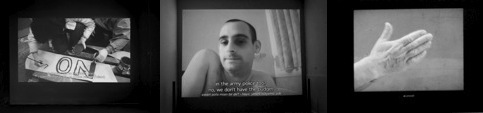
Ruti Sela & Maayan Amir’s 'Beyond Guilt' <2004> further emphasises this notion. The female artists registered on an online dating website and invited men to come to a hotel room in Tel Aviv. It is unclear whether the men were misled about the girls’ intentions, however this is quickly overlooked as a party ensues and conversation flows. 'Beyond Guilt' challenges the viewer's comfort zone, addressing gender role, power and social taboo. As the film develops, references to war and the atrocities the men have committed begin to consume the conversation. The film's intimate setting, focused on human relationship, means Ruti and Maayan successfully depict a society overshadowed by an omnipresent war.
Nevin Aladağ's work 'City Language I, II and III' provides a welcome break from the constant repetition of conflict, protest and mock-militarism evident within the biennial. Aladağ creates poetic vignettes of Istanbul: 'City III' is a single screen shot of hands clapping – with each clap the hand changes to different citizens of Istanbul whilst the sound of the claps resonates throughout the space. This is a simple yet effective work as it visually depicts diversity within the city, leaving behind an overt political agenda which I felt many of the works had.
Overall there was a feeling of claustrophobia, particularly at Antrepo. Many of the works were crammed together, not leaving enough space between artists. The constant repetition of politically abrasive and overt works disengaged the viewer, with the understated often lost within the rabble.
Yet what makes 'What Makes Mankind Alive' successful is its delivery of a tightly-curated theme evident through meticulous attention to detail. The collective assumes the role of militant-cum-Neoliberal Capitalist: from the delivery of their opening speech, carefully choreographed in a militaristic style – all four on stage standing to attention, projecting their voices, clearing their throats in unison; to the dominance of red and black in the publications that are saturated with statistics and graphs. They poke fun at traits associated with the military, capitalism and activism, thus reinforcing their theme that art should reflect politics.
11th International Istanbul Biennial 12-09-09 ‘til 08-11-09
http://www.iksv.org/bienal11/
http://www.culture.pl/en/culture/artykuly/os_zmijewski_artur
http://www.infocusdialogue.com/artists/ruti-sela-maayan-amir/
http://www.gitteweisegallery.com/aladag/index.html