"Welcome to the Pleasuredome"
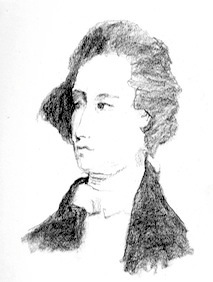
As multiplex screens beam 3D cinema to an eager audience of millions, it might be instructive to ponder the beginnings of this illusionary communal experience. An elaborate multimedia event whose principle aim was the seduction of a thirteen-year-old boy, the 1781 Christmas party held by the millionaire aesthete William Beckford at Fonthill House was a triumph of speculative technology and the stuff of great scandal. This orgy was a spectacle to derange the senses by special effects, a venture aided by the artist Philippe Jacques de Loutherbourg to create "a mysterious something that the eye has not seen nor the heart conceived". It caused an outrage that would see Beckford banished to European exile for decades.
Heir to a huge fortune bequeathed from his plantation-owning father, by the age of 21 Beckford was already a renowned art collector and writer, reputed to be "the richest commoner in England". Staged at the height of a mania for all things Arabian and Oriental, Fonthill was the setting for an exotic spectacle that would ravish the senses of his guests. Loutherbourg, chief scenographer at Drury Lane theatre and the inventor of the Eidophusikon, a commercial "moving picture" entertainment, found himself duly entrusted with the commission. In the invite, Beckford had promised to "give our favourite apartments the strangeness and novelty of a fairy world", and the guest list of a privileged half-dozen included the young William Courtenay, son of Lord Courtenay and the true object of Beckford's fixation. Also present was Louisa Beckford, 34, his own cousin's wife who had written in reply, "William - my lovely infernal! How gloriously you write of iniquities... like another Lucifer you would tempt Angels to forsake their celestial abode, and sink with you in the black infernal gulph". For this three-day festival of erotic enchantment, celebrants were sealed inside the abbey's labyrinth hallways and illuminated rooms to lose themselves in the multiple full-length mirrors, golden and blue flowered ceilings, orange velvet curtains and thick Persian carpets. Although no detailed descriptions of the party survive, Beckford's own account in a note of 1838 gives a hint of the ecstatic scenes enacted there: "I seem even at this long distance to be warmed by the genial artificial light that Loutherbourg had created throughout the whole of what appeared a necromantic region... it was the realization of a romance in all its fervours, in all its extravagance." The party left Beckford in a state of emotional turmoil, and in early 1782 he would write the fantastical gothic novel Vathek in French during three days and two nights of fevered inspiration, later claiming, "you will hardly credit how closely I could apply myself to study when young." In his 2007 paper The Virtual Infernal, Iain McCalman argues the case for the Fonthill debauch being a prototype for future immersive experiments: "Ultimately this saturnalian party of Christmas 1781 constituted a pioneering experiment in applying the aesthetic of the sublime to virtual reality technology" , an idea worth entertaining next time you're settled down before the latest CGI-enhanced Hollywood confection. All our yesterdays' parties pale into insignificance when we know that love has left forever and all that remains in life are distractions, distractions which ultimately heighten the pain of the loss, the loss counted in seconds, minutes, hours, days, weeks, months and years, a lifetime of loss cannot be replaced by art or humour, fine clothes and possessions, grand houses and gardens, all that beauty only serves to remind us of the beauty lost, the beauty of a first love at play at a party designed and built on the might of that love. First love never leaves us, it serves to remind us of the loss of joy and innocence, it informs and guides us in future loves and affairs, our hearts never beat as fast again, experience takes over from the innocence of performance and in that transition maybe all is lost only to be recalled through memories, so careful who you choose to share those 3D glasses with. The final paragraph in Vathek, where it is widely acknowledged that Vathek is Beckford and the youthful Gulchenrouz is William Courtenay, reads: 'Thus the Caliph, Vathek, who for the sake of empty pomp and forbidden power, had sullied himself with a thousand crimes, became a prey to grief without end, and remorse without mitigation; whilst the humble and despised Gulchenrouz passed whole ages in undisturbed tranquillity, and pure happiness of childhood'