"Terror Haza: Museums as Art"
On a wide grassy street in Central Pest stands a monument to the victims of two horrific regimes that reigned over the Hungarian people for more than fifty years. Publicly commissioned works of art commemorating historical events are not uncommon in cities across Europe with Budapest as no exception, yet the monument that sits on this leafy street is not your average gilded bust. This monument is the former building that housed the administrations of terror. This is 60 Andrassy Ut.
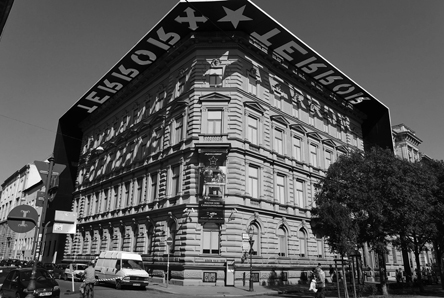
The Terror Haza (House) is a museum about the Hungarian people's plight under the Nazi and Soviet regimes spanning the decades of the Second World War until the late sixties. What captivated me whilst conducting my visit was its use of contemporary art techniques to convey history. It seemed that the museum's curatorial team had turned the building into a work of 'art' both internally and externally. As you approach the building it is hard not to miss the giant metal overhang that frames its façade. The word "terror" has been cut out and casts an ominous shadow over the building in the harsh midday light. It has been painted a stark matt grey with its windows blacked out contrasting to its sandstone neighbours and is reminiscent of a Rachael Whiteread sculpture. Small oval, sepia toned photographic plates of the victims of the two regimes line the perimeter of the building, all contributing to a visually arresting sight that instils a sense of foreboding and evokes these once omni- present regimes before you step into the museum.
The permanent exhibition is a carefully choreographed sequence of rooms denoting the linear passage of time of the two administrations. It seamlessly incorporates video and sound with a specially commissioned score playing throughout the exhibition. Early on you enter a carpeted room lined with widescreen monitors and cone-like structures placed across the room. The videos are archival footage of survivors describing their experience of Soviet Work Camps. Each video is timed, and as each screen plays it gently navigates you through the space. As you advance, you become aware that the carpet is a map of Hungary and the cone-like structures, which contain artefacts, are in fact giant map pins denoting where the objects were found, with its geographical spot correlating with the content of the videos. The cone's purpose is to house the artefact, yet in its present form as map pin it takes on a more sculptural quality, transforming it from display cabinet to art object. This integration of video, space and object is without fault, with each element of equal weight within the space. Another example of historical information displayed as art object is a passage denoting the farmers' struggle with Soviet administration. The passage is made entirely out of soap with dates and names inscribed into it, and would definitely not be out of place in any white cube.
I could wax lyrical about many other aspects of this museum that I found to contain parallels to contemporary art, but I won't. What I will say is that the symbolic nature of the exhibits within the Terror Haza means that it should be considered in a contemporary art context as well as an historical one.