"A Call to Action in the Year of Creative Scotland"
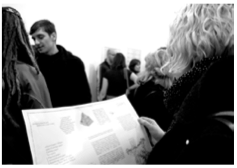
On the 17th of February I opened a pop up exhibition held in an empty shop in Glasgow, it was called ‘On Paper’, and it looked at how 9 artists from across Scotland used the materiality of paper. The exhibition attracted around 250 people, ran for one week and cost £196 to produce. This is not an unusual situation; in fact it happens most weekends somewhere in Scotland. Yet as we were installing, the story broke about the Public Entertainment Licence with particular focus on Glasgow City Council. Hailed as a ‘Tax on Creativity’ the amendment of the existing Public Entertainment Licence will come into force on the 1st of April. This new amendment extends the need of a licence for all events open to the public, regardless of whether they are free or not. Thus temporary exhibitions, screenings, readings, performances, fun days, workshops, gigs etcetera - whether staged in your flat, or in a cafe or empty shop or outdoors - will have to obtain a licence. ‘On Paper’ would have fallen under this category. I would have had to pay a minimum charge of £120 and engaged in an application process which would take up to six weeks. The exhibition was arranged, hung and dismantled in less than 4 weeks.
Within days, opposition to the proposed amendment had gathered pace across social media platforms and in the press, with high profile ambassadors such as Franz Ferdinand and Alasdair Gray speaking out against the ridiculous amendment to the law and how it will stifle the Glasgow grassroots art scene: a scene of which curator Hans-Ulrich Obrist coined the name ‘the Glasgow Miracle’ and the Art and Humanities Research Council has just awarded a sizeable grant to the Glasgow Art School to research. As little as two weeks passed and the Glasgow City Council had bowed to the increasing pressure and issued a statement that it had suspended the need to acquire a licence whilst they conduct a six month consultation period. What we didn’t know but has now transpired is that this amendment affects all councils across Scotland. So what of the other 31?
Edinburgh-based artists are staging a day of unlicensed activity on the 1st of April entitled A Little April Foolery, initiated by director Jen McGregor. Jen encourages anyone to get involved:
“Edinburgh artists should stage as many unlicensed events as we can. Anything at all. As long as it’s art. As long as it’s entertainment. As long as it’s open to the public and free of charge. Find a location and do your thing. Publicise it or don’t. Show off your pictures, burst into song, wax poetical, make a scene, find an audience! Just don’t apply for a licence.”
The latest gaff has been that an Easter egg hunt in the Highlands will have to apply for a licence which would cost the community group £153. Dundee City Council’s policy is that exhibitions will be exempt, however in order to do this the council has to engage in a consultation period defined by resolution of section 9 in the original bill of 1982. Therefore, as it is understood, until the consultation period is initiated all activity will have to be licensed after the 1st of April. Dundee City Council has not yet engaged in said process.
It is looking likely that even if community groups don’t have to pay for a licence they will still have to apply for one which is at the discretion of the licensing board. This fundamentally acts against the definition of the UN’s cultural rights which will drive community-led cultural activity underground, and will ultimately lead towards an homogenised, corporate-endorsed view of cultural activities in Scotland. We must collectively stand up for this amendment to be scrapped. Lobby your local councillor, sign the petition, stage an unlicensed event on April the 1st, but most importantly spread word of the amendment to friends and family, outline that it is not just the arts that are in jeopardy but ALL cultural activity.
Would I do another event similar to ‘On Paper’ after the 1st of April? Yes. I am in the process of establishing an organisation in the east end of Glasgow called 27. We, like similar organisations, are starting out on an ad-hoc basis putting on events and exhibitions whenever we can on a minimal budget. Like the majority of artists I know, I am on the lowest income bracket in the UK. If I had to pay a licence fee every time I wanted to stage an event in a temporary space I simply could not afford to do so - and, by definition of ad-hoc, the time constraint attached to applying for a licence negates the purpose. In short, the measures put in place by Glasgow City Council are temporary if after the consultation period is over the council decide to reinstate the licence I will be forced to operate illegally and I won’t be the only one.
Further reading:
Universal Declaration of Human Rights (1948) (article 27)
Cultural rights are incorporated in article 27: “Everyone has the right freely to participate in the cultural life of the community, to enjoy the arts and to share in scientific advancement and its benefits. Everyone has the right to the protection of the moral and material interests resulting from any scientific, literary or artistic production of which he is the author.
Sign the petition: http://www.change.org/petitions/the-scottish-government-scrap-public- entertainment-licence-fees
Neil Mullholland’s article which eloquently demonstrates why this amendment will quash Scotland’s hope for independence http://bellacaledonia.org.uk/2012/03/03/can-play-wont-pay/
Find out who your local councillor is http://www.writetothem.com/
Join the Facebook group http://www.facebook.com/scrapartstax
*The artists involved in ‘On Paper’ were; Rachel Barron, Pete Fleming, Ross Hamilton Frew, Sarah Laing, Chris Hugh McKenzie, Ewan Manson, Callum Monteith, Jonathan Owen and Erik Smith. 27 is a new organisation set up by Gayle Meikle and Ross Hamilton Frew which amongst other things will help Scottish based artists realise projects. You can view documentation of the exhibition and keep up to date with news on 27 at http://www.facebook.com/gallerytwentyseven