"Day is Done: Dennis Cooper on Mike Kelley at the Stedelijk Museum"
A sprawling overview that featured 200 artworks and attracted over 200,000 visitors, Mike Kelley’s Themes and Variations from 35 Years at Amsterdam’s Stedelijk Museum was intended as a mere mid-career survey. Planned in close collaboration between curator Eva Meyer-Hermann and the artist himself, all of that changed with Kelley’s suicide in January 2012 aged 57. The survey became a retrospective with a chronological hang, and the unruly force of nature was duly historicised and preserved forever within the art hall of fame. A few weeks ago I took the ferry there with my mum, keen to experience the work of an artist who has shaped my thinking ever since I first saw A Domestic Scene, so very horrifying and hilarious, over a decade ago.
An afternoon at the Stedelijk was hardly enough time to do the show justice. Working across an array of media, Kelley’s oeuvre is labyrinthine in its complexity and demands serious thinking time from the viewer. Talking to my mum afterwards, I remarked on how incredibly funny the show was.
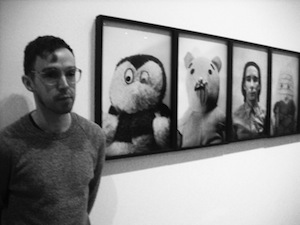
“I wish you’d told me that before we went in,” she said, “I didn’t realise it was all meant to be a big joke.” While it’s true that humour is always subjective and the subject matter of memory and abuse hardly suggests a laugh riot, jokes were everywhere in this exhibition. The placing of used cuddly toys on a dirty ragged blanket on the floor of a pristine spotless museum: that’s a joke, right? And the paintings of transsexual models and the kids being tortured on YouTube, all of it’s funny after a fashion.
Starting in the Stedelijk basement with his 70s work as a Cal Arts graduate student, the early Kelley adorns the gallery walls with a conflagration of text and image, the words clashing and often screaming in a cacophony of different registers. These large posters functioned as scripts for his performances, alongside ‘demonstration objects’ that still have the residue of obscure and absurd meanings clinging to them. Other rooms were decorated with huge felt banners carrying baffling slogans. “Did he just keep all this work in a big warehouse somewhere?” my mum asked. “No, collectors did want to buy it, eventually.” Kelley’s conquering of the art market is a subtext for his production throughout this period. From the 80s we see the now- canonical soft toys, most famously in the 1987 used rag doll landscape More Love Hours Than Can Ever Be Repaid, onto the 2000 Memory Ware sculptures of plastic jewels and bottle tops, and then the triumphant Day is Done gesamtkunstwerk that took the New York art world by storm in 2005. The Gagosian Gallery was filled with projections of ceremonies extrapolated from Kelley’s high school year book photos, now probing their underbelly for queasy thrills and giggles. A selection of these films was on display here along with props, costumes and sets. The multimedia overload was described at the time by Village Voice critic Jerry Saltz as “clusterfuck aesthetics”, and that was manifest at the Stedelijk.
The Variations of the show’s title were a reflection of the recurring subjects that underpinned all Kelley’s art here: the repressed underside of culture, the hidden trauma beneath memory, the toppling of art- historical hierarchies. What’s clear now is that his influence on subsequent generations of artists has been huge and profound. The critic John C. Welchman, co-director of The Mike Kelley Foundation for the Arts, puts it that Kelley was “a counter-culture warrior fighting for the release of the voices and skills he always felt that mainstream institutions kept in positions of muteness or invisibility.” I’m just grateful that he won his battles so convincingly.
Dennis Cooper is an American writer now living in Paris. In addition to being a novelist, poet, critic, editor and performance artist, Cooper has a long history as a committed zinester. His legendary journal Little Caesar, founded in 1976 New York, featured contributions from Andy Warhol and Debbie Harry among a great many others. Cooper is also a blogger extraordinaire whose daily Blogspot page has been an invaluable source of encouragement and connections for Yuck ‘n Yum from the very get-go. A longtime friend of Mike Kelley, he very graciously answered our questions:
How have zines been a part of your life?
-- Well, the first thing I ever made for public consumption was a zine called ‘Flunker’ when I was 10 years-old. It was a satirical zine inspired by Mad Magazine, which I was really obsessed with at the time, and that I wrote and drew by hand. I made about 7 or 8 copies of each issue and sold them at my elementary school. Then in the mid-70s, I started a punk-inspired lit and art magazine called Little Caesar that I think counts as a zine because it was a one-man operation, even though most of the 12 issues were offset printed. I edited and published LC until 1982. Other than that, I’ve just been a big fan of the form. During the queer punk heyday in the early 90s, when there were hundreds of related zines being put out, I collected as many as I can, and they’re now in my archives at NYU.
What is your experience of zine publishing?
-- Flunker and Little Caesar were my only serious forays into zine publishing. I guest-edited issues of a few zines here and there, and I edited an anthology of writing and comix from queer zines called Discontents (Amethyst Press, 1994).
What are some of your favourite zines, old and new?
-- I’m a huge fan of the zines masterminded and co-published by Johnny Noxzema in the 90s like ‘Bimbox’, ‘Double Bill’, ‘SCAB’, and others. Another all-time fave is Steve Lafreniere’s ‘Gentlewomen of California’ from the same era. Scott Treleaven’s ‘The Salivation Army’. I don’t know, there are so many zines I like a lot, past and present.
What were the circumstances of your first meeting with Mike Kelley?
-- I knew about Mike for maybe a year before I met him. A great number of my friends in the late 70s and early 80s were artists and writers who were recent graduates of Cal Arts, and most of them had attended school with Mike. Almost to a one, people whom I knew absolutely revered him and considered him to be a total genius. He was mostly making performances at that time, and there wasn’t much physical work by him to see, so I knew about his work only by reputation. When I first started hearing about him, he was living in Detroit for about a year, but then he moved to LA. I think I saw a couple of his performances before I actually met him. I don’t remember our first meeting, but it was probably at an opening or a reading or a music gig.
I do remember that I gave a reading at LACE in 1981, and that Mike came up to me afterwards and raved about it, which was a huge and mindblowing honor because, by then, I had seen his work and was as in awe of him as everyone else.
Mike and I became very good friends. The LA art and writing and music scene was very tight and mixed and friendly, and the young artists and writers and musicians and so on all hung out all the time, sometimes at LACE for visual art events, and sometimes at Beyond Baroque where I was programming readings and performances and concerts, or going to see music at local venues, etc. People were always collaborating together on projects – videos, band projects, one-off art works, drawings, and so on. Mike and I made plans to create a Goth Rock Opera together, and we worked on and planned it, but it never actually came about, mostly because Mike became internationally successful and very busy at a certain point. When that happened, Mike started holding up in his studio and working a lot, and he socialized less, but I hung out at his place a lot for years, and only stopped seeing him regularly when I moved to Paris in 2005.
When I saw the show at the Stedelijk last week, it was the first time I’d encountered most of those works in the flesh. I was struck by how much presence everything had, which just cannot be captured in photographs.
-- Yeah, I don’t think Mike ever made work with the idea in mind that most people would end up encountering it in reproduction. I think maybe his roots in performance might have something to do with that. Physical presence, scale, the organization of the work in the room, etc., are very key to how his work functions always, I think, even when his work is at its most ostensibly simple seeming.
Some works were surprisingly poignant. I’m thinking of the Kandor series, based on various reconstructions of Superman’s home city, and Mechanical Toy Guts, the skeletal remains of robot toys making broken, strangulated sounds. In different ways, each carried sone emotional heft.
-- Yeah, I feel like Mike’s later and last works were his most emotional. That final piece in the Stedlijk show, with the skinned toy animals, which Ann Goldstein, the head of the Stedlijk, told me was one of Mike’s very last works, was especially disturbing and heartbreaking, I thought.