"I CAN HAS HISTORY: The Genealogy of Lolcats"
We live in an eternal now and nothing has ever happened before this present moment which is just common sense and part of the way we are. Or so we might sometimes think, because the constant deluge of images and texts that we see every day drills this way of thinking into us as fact. But maybe things evolve and maybe they grew from something different. Different, but still recognisably this. Take lolcats for instance.
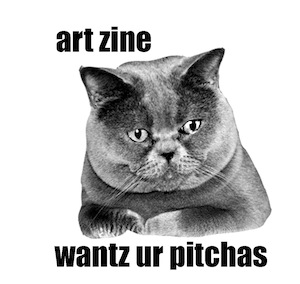
Lolcats are image macros that show cats displaying human character traits alongside text that is deliberately mis-spelled and grammatically incorrect. This text is usually capitalised and written using the sans-serif Impact typeface. Maybe the definitive lolcat is that presented by Eric Nakagawa on the Something Awful online forum in January 2007. It showed the world a smiling rotund British Shorthair with the caption “I can has cheezburger?” and gave its name to the popular weblog starring hundreds of wisecracking animals with a poor grasp of the English language. A disclaimer: your correspondent has never lolled at a lolcat. But plenty of other people have, and they’ve been laughing at anthropomorphised cats for a very long time. This article seeks to provide a few examples.
The lolcats’ family tree can be traced back to 1870 when the Brighton photographer Harry Pointer began arranging his cats in humanoid poses. His carte-de-visite portraits were already popular, and for his ‘Brighton Cats’ series Pointer dressed up his pets and added captions to the pictures. “Bring up the dinner Betsy” said one such group of felines. Note how these cats were expressing hunger at a stretch of 137 years, still craving cheezburger even then. Other texts included "A Happy New Year" and "Very many happy returns of the day", and were often sent as tiny greetings cards to prospective clients or circulated among fellow cat lovers. This motif of hungry cats with fastidious English continued with the American photographer Harry Whittier Frees, whose 1905 postcard of a cat sat propped on a highchair and dressed in quaint period costume asked the question “WHAT’S DELAYING MY DINNER?”
The German illustrator Arthur Thiele was a prolific creator of postcards featuring humanised cats and dogs around the turn of the century. The most strikingly similar to our modern conception of the lolcat was painted with a bandaged head and swollen eye, whose neatly handwritten caption advised “you ought to see the other fellow.” Keen-eyed observers of lolcats etiquette will note that standards of spelling and grammar are still strictly adhered to by this point in their history.
We journey further into the advertising-saturated 20th century to find another lolcat precursor being used in the March 1929 issue of Parents' Magazine. “A Genuine Photograph of THE LAUGHING CAT” promises to brighten up the whole room, offering itself as “The Perfect Picture for the Nursery”. This would confirm that any sympathy for lolcats must be essentially infantile by nature. “Ha, Ha, Ha, It must be so!” read the subtitle. By 1969 the cat photo was used as a motivational poster, a big eyed kitten shown hanging from a tree branch, imploring the viewer to “Hang in there, Baby!” This image was widely adopted as a 1970s cultural relic, a form of visual shorthand used to gee up a doleful Marge in a 1997 episode of The Simpsons and orally as a motto in the 21st century spinoff series Terminator: The Sarah Connor Chronicles.
All of which brings us to the eventual lolcat triumph in our present era of instant messaging and online imaging, when a cute cat juxtaposed with text is a form of speech universally acknowledged among the moneyed social networkers of the western world. The lolcat as we know it today originated on the English-language image board community 4chan for an event called Caturday in 2006. According to the knowyourmeme.com entry for Caturday, “A LiveJournal community for Caturday image macros was created on February 5th, 2006” and “search for Caturday peaked in June 2007, coinciding with the creation of I Can Has Cheezburger? and popularity on sites like Fark and other message boards.” As with all internet memes, we see an initial explosion of interest before a plateauing out to the present. The first wave of lolcat popularity was followed by an inevitable backlash, when the Averagecats website depicted cats with soberly objective slogans: “THIS CAT does not specifically want a cheeseburger. It is merely hungry and would accept any food offered to it.”
Today we all know lolcats as an instantly recognisable form of speech. In winter 2010 a lolcat-inspired flyer even advertised the upcoming deadline for Yuck ‘n Yum. That same year, at the USA Democrat-affiliated Rally to Restore Sanity and/or Fear in Washington, a protestor held aloft his placard with a scrawled drawing of a cat’s face next to the slogan “I CAN HAZ FEAR”. The understanding of this mantra is passed between a proudly liberal, cosmopolitan and self-congratulatory urbane elite that confidently uses whimsy as a weapon in the culture wars. The lolcat is a specialised form of code and to get it, you have to be in on the joke. As ever, he who lolz last lolz longest.