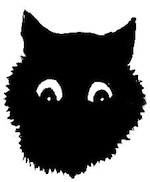
"The Doubly Nature of Louis Wain"
"I take a sketch-book to a restaurant, or other public place,
and draw the people in their different positions as cats,
getting as near to their human characteristics as possible.
This gives me doubly nature…”
-Louis Wain
When I was a child, I was very fascinated with the subject of mythology, primarily that of the ancient Greeks and Egyptians. The Egyptian gods in particular were my favorites: zoomorphic beings with human bodies and animal heads, they struck me as being much more exotic than the formless God I worshipped at Mass every Sunday. Years later, this interest in the gods of Ancient Egypt would again manifest within my life in the form of the Typhonian Trilogies of the English occultist Kenneth Grant. Grant would often direct the reader’s attention to the fact that most of the Egyptian gods and goddesses were of a dual nature: much has been written on the duality of the relationship between Horus and Set, which is one of the first great clash of opposites. However, this dual nature can be seen in other gods from those dark Draconian dynasties of Antiquity: consider Bast (or Bastet), the primordial Great Mother of the Egyptians and defender of the pharaoh, who was said to give birth (or “catted”) without male intervention. A feline goddess, Bast personified lunar powers and was associated with the North: her opposite was Sekhet, the lion-headed war deity of the South. The Ancient Egyptians were one of the world’s first civilizations to understand the double-sided nature of things, a concept that has since manifested everywhere in our culture, from psychology (Jung’s conception of “The Shadow”) to literature (Dostoyevsky’s The Double) to films (everything from Hitchcock’s Shadow of a Doubt and Strangers on a Train to Darren Aronofsky’s Black Swan, to use a more recent example). And I think that this “doubly nature” (to use the terminology of the subject of this article) can also be seen in the work of English cat artist Louis Wain (b. August 5th, 1860-d. July 4th, 1939).
I most likely never would have heard of the man were it not for the fact that his art has been championed by the English musical group known as Current 93, whose mastermind, David Tibet, is a great admirer of Wain’s work; in fact, Tibet has sometimes referred to Wain as the greatest artist of all time. Wain’s shadow looms large over the discography of Current 93: Wain’s artwork can be found serving double-duty as the cover art of various Current 93 releases (such as the 1994 re-release of the Current’s 1992 album Thunder Perfect Mind, 1995’s Where The Long Shadows Fall, and the 1995 VHS release Since Yesterday: A Peek In The Pit). Also, some of Wain’s writings, gnomic scribblings that could often be found on the back of his paintings, have been utilized on the album tracks themselves (see Phoebe Chesire’s recitation of some of Wain’s text on the track “A Voice From Catland,” the opening song of 1994’s Of Ruine Or Some Blazing Starre, an album dedicated to Wain’s memory).
Louis Wain was born on August 5th, 1860, in Clerkenwell, England. The first of six children (and the only male of the group), he found himself supporting his mother and sisters following the death of his father when he was 20 years old. Wain gained some success as a freelance artist, drawing naturalistic animals and country scenes, and at one point he planned on making a living by drawing portraits of dogs. This all changed in the 1880’s, when he married Emily Richardson, who was ten years his senior. Three years into their marriage she died of cancer, and during her illness he would try to amuse her by teaching their pet cat, Peter the Great, to perform silly tricks. This eventually led to his obsession with cats. In regards to Peter the cat, Wain wrote, “To him, properly, belongs the foundation of my career, the developments of my initial efforts, and the establishing of my work.” Like a superhero from a 1950’s comic book that gains his powers upon stumbling across a magic ring or an odd-sounding word in a wizard’s book, Wain had found the source of his own artistic powers. Peter the Great was to Wain’s art what the radioactive spider that bit Peter Parker was to the genesis of Spiderman.
In 1886, Wain’s first anthropomorphic cat drawing (A Kitten’s Christmas Party) premiered in the Christmas issue of Illustrated London News. As such pictures of anthropomorphized animals were popular in Victorian England, Wain eventually found himself in some demand, and he began churning out his cat artwork: being somewhat prolific, he produced over several hundred drawings a year. With his work, he sought to wipe out the contempt that he felt England had towards cats, and in his own way, through his art he elevated them almost to the heights of divinity, in much the same way that some nobles of Ancient Egypt worshipped cats. And even though he often portrayed his comically big-eyed cats doing human activities, their inner felinity could never be completely masked. Sadly, following the death of Wain’s mother in 1910, the first signs of his schizophrenia became manifest, and he would end up spending the last 15 years of his life at the Bethlem Royal Hospital, where he continued to draw cats until his death in 1939.
Some of my favorite works of Wain are the “electric cat” paintings he did towards the end of his life. These somewhat psychedelic works of art (which look like stained glass windows from some futuristic church dedicated to cat-worship) strike me as being the feline counterparts of the Sacred Mirrors series created by New Age artist Alex Grey, whose own work usually depicts glowing, x-rayed human bodies interconnecting with multiple layers of reality. In my opinion, Wain is perhaps the only artist through all of human history who managed to successfully capture, with his pen and paintbrush, what the soul of a cat might look like, and I feel that this can best be seen in these later “electric cat” paintings. I like to think of Wain as a Gnostic in some ways, in that with these odd paintings he strips away our surface image of cats and shows us the bejeweled and shimmering etheric beings that possibly lie behind what we think of as reality.
James Champagne's Grimoire is published by Rebel Satori Press.