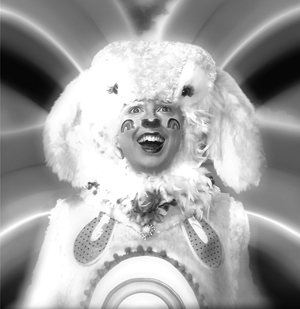
"It's Almost Like a Triple Rainbow: An Interview with Rachel Maclean"
In May 2013 the mystically talented Glasgow-based artist Rachel Maclean premiered her new film Over The Rainbow at Edinburgh's Collective Gallery. Co-commissioned by the Banff Centre, Alberta, Canada after Maclean undertook a Creative Scotland-supported 6-month residency there, Over The Rainbow is a hugely ambitious CGI fantasia with Maclean as the sole actor and model playing a roll-call of parts. Identities, appearances and realities are scrambled through an all-consuming, ravenous mass-media, as dreams and desires of escape are all fed back in on one another. Eager for an interview, I could sense that getting a handle on Maclean’s motivations in creating this artwork would be no easy task. Unperturbed, I forged on ahead regardless:
The "Double Rainbow Guy" whose monologue opens this film is emblematic of a particular type of character in your work. Faced with a profound experience, be it true love or the sublime in nature, these archetypes can only express their emotions back into the hall of mirrors that surrounds them. I wonder, is there a tragic impulse at work here, in addition to a romantic one?
Woah, oh my god, look at that, it's starting to look like a triple rainbow, double rainbow all the way across the sky, oh my god.
Each individual in these scenes appears to be searching for an intimacy that is then denied them. Would that be a kind of allegory for our situation in the diaspora of late capitalism?
Well I like you too, would you like to come home with me, little doggy? And we could be good friends, what do you say? We can go for walks and have lots of fun together, would you like that?
Your work could be seen as a kind of critique of cultural authenticity, in the sense that there’s some degree of confusion as to the artist’s genuine voice. Walter Benjamin linked this shift from authentic objects to broadly accessible mass media with a transformation in the function of art from ritual to politics. Would it be true to say that your work is a fulfillment of his prophecy?
Oh god. What does this mean? It’s so bright. Oh god, it’s so bright and vivid.
The Death of the Author, in a post-structuralist sense of the term.
This is what she used on my brother and her sister. We found parts of the bodies all over the house. In places you wouldn’t think. The funny thing is, the heads have never been found. The hands and feet and things like that, but no heads. You can hear them at night. They whisper to each other and then cry.
Of course, the plateauing of formerly distinct identities is something that we see occurring across various cultural forms. Hip hop’s assimilation into the mainstream is a defining example. As it has become less of an underground culture, there is debate over whether the spirit of hip hop can survive in a marketable integrated version. Would you agree that your work is, in a way, somehow paradigmatic of this?
I got freaky, freaky baby, I was chillin’ with my ladies I didn’t come to get bougie, I came here to get crazy I was born to get wild, that’s my style, if you didn’t know that, well, baby, now you know now, ‘cause I’m havin’ a good time with you, I’m tellin’ you I came up in here to rock! Light a fire, make it hot! I don’t wanna take no pictures! I just wanna take some shots! So come on, let’s go! Let’s lose control! Let’s do it all night! Until we can do it no more! Keep on rocking to the sound! Turn it up and watch it pound! We gon’ rock it to the top, until the roof come burnin’ down!
In terms of your career’s overall trajectory, I think it’s fair to say that Over the Rainbow is a kind of son et lumière show of your various strategies, one that serves as a kind of summation of your own very singular aesthetic. Do you envisage these themes of fantasy and escape offering any further scope for critical analysis?
I feel so nervous, because the song I’m going to sing for the finals is a hard song to sing. I wanna do the best that I can because, if I win, that would mean that my dreams would come true.