"Zine Q&A with Graham Domke"
I wanted to sit down and chat with DCA Exhibitions Curator Graham Domke about zines, Yuck ‘n Yum, and the future, but we are living busy lives, so I had to settle with some questions and answers via email. I am not complaining, last night was a busy one at DCA; the preview for Trisha Baga’s exhibition Holiday and the launch of the Torsten Lauschmann book Startle, and today he was taking care of a myriad other things, before soon jetting off to work on an upcoming exhibition.
M: How have zines been a part of your life?
G: As a hoarder and a collector they can have a power to become documents to things you witnessed or missed. Their immediacy means zines can be reportage.
M: What is your experience of zine publishing?
G: My publishing tends to be a bit more fancy - incorporating spines, binding, proofing, but it also tends to come out six months after the fact. Little text pieces here and there and I’ve made small self published works for shows I have done in artist run spaces - from a double-sided A3 sheet folded down and cut in the middle to form a pamphlet, and held to that spirit when I did The Associates at DCA with leaved booklets aspiring to look like the ‘inkies’ of my early youth.
M: You worked with YnY for the Artists’ Books exhibition as part of Book Week Scotland this year - why involve them? How do you see YnY in relation to Dundee, to Scotland, to zines?
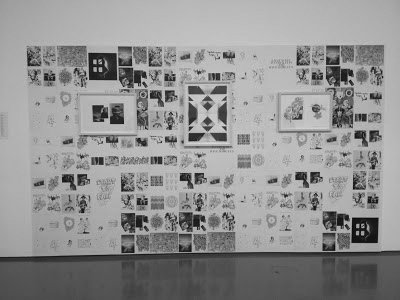
G: Yuck ‘n Yum is contemporary, inclusive and chancy which is what I try to be. I wanted to reflect that alongside the now canonical artists like Ed Ruscha, Lawrence Weiner, Sol LeWitt and alongside the copies of Aspen we showed. I thought YnY fitted well, especially alongside the Raymond Pettibon zines for SST. DCA tries to combine a local and an international perspective to the programme and so it felt like a fit. There were DCA visitors who had never come across YnY before which I find amazing.
M: What do you think is important about the physical component of zines, and their community, now that it is nearly 2013, and with the ubiquity of the Internet in large parts of the world?
G: Zines have unexpurgated potential and are tangible to hold in your hands. This kind of publishing is not about the commercial and more about the act of making it and sharing it with your community of friends and people you would like to be friends with. The internet is a little bit daunting for the micro world of zines. The energy consumed dealing with the page-turning on Google kind of goes against the less carbon cottage industry of the self published and the low numbered. And the very sophisticated, predictive aspect to search engines - plus I’m a luddite.
M: What are some of your favorite zines, old and new?
G: Some of my favourite zines are by major artists - I cherish my Thomas Hirschhorn A3 daly releases at the Bijlmer Spinoza Festival from 2009. The one I most wish I had is Dimanche - Le Journal d’un Seul Jour by Yves Klein. I also love that Lucy McKenzie made Poppy and Violet when she was making music and beginning as an artist. I also like what Malcy Duff and Valerie Norris do these days.
M: For my part: I grew up in Seattle and zines were a huge thing during the time I was in High School; I even made one for a language arts project and convinced my teacher to photocopy enough for the whole class. The zine had lots of angsty poetry, collage, a word jumble, and an article about industrial hemp. I kept reading zines I could pick up from people or shops around town (Left Bank Books, to name one), and every once-in-awhile I made more of my own. I also did a lot of small-press and bookmaking too. The ethos of DIY, sharing stories and information, through cheap printing methods was something I grew up with. Because there were ample ways to find zines in Seattle I never knew about Mike Gunderloy’s Factsheet Five, but I’ve learned that it was a huge resource for a lot of zinesters, especially pre-Internet.
When I moved to Pittsburgh I met other people interested in zines. I met a kick-ass lady, artnoose, whose letterpress zine Ker-Bloom has been a bi-monthly release for over 16 years (ker-bloom.tumblr.com) and many other great people, some of whom are in the Justseeds collective (justseeds.org). I also really like independent comix - so the shop, Copacetic, was a place to find great stuff from all over. The Carnegie Library presented a Feminism and Zines Symposium in Spring 2011, with talks from Alison Piepmeier (author of Girl Zines: Making Media, Doing Feminism), Sara Marcus (author of Girls to the Front: the True Story of the Riot Grrrl Revolution), and Jenna Freedman (of the Barnard Zine Library: zines.barnard.edu).
In Scotland I first stayed in Edinburgh, and went to Yuck ‘n Yum’s summer launch at Superclub (superclubstudios.com). I liked what I saw (incredibly strange as it was) and made sure to find them when I moved to Dundee to attend DJCAD. Satellite Zine, the student produced zine, also caught my eye, and I began working with them last year as editor for issues 6, 7, and 8. I like the physicality of zines and small press publications. I think the Internet is also very valuable for distribution and accessibility: see the Queer Zine Archive Project (qzap.org), No Layout (nolayout.com), and many more. But the feeling of a zine in your hands has no comparison... yet.
Some of my favorite zines include: Doris (dorisdorisdoris.com), Shotgun Seamstress (afropunk.com/profile/osa), Cometbus (en.wikipedia.org/wiki/Aaron_Cometbus), King-Cat Comics (king-cat.net), The Kurt Cobain Was Lactose Intolerant Conspiracy Zine, Clitical Mass, and loads more.