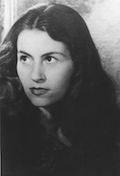
"FRIENDS FEAR FOR UNICA: The abridged life of Unica Zürn"
Unica Zürn’s intense gaze stares out from photos, defying any viewer to return it. Her look is troubled and alluringly unknowable. Remembered best now for her automatic drawing, her anagrammatic poetry and some intense, heavily autobiographical writing, she’s a pin-up for the despairing, the girl most likely to somehow cause a scene.
Born in Berlin in 1916, Zürn grew up surrounded by exotic objects collected in Africa by her adored cavalry officer father. They resided in a well-to-do Grünewald household that could have served as a Freudian case study. She went on to work at the German state film studio UFA and married a much older man in 1942, losing custody of their two children after a divorce seven years later. She did some painting and drawing, chanced upon the Surrealist technique of decalcomania and wrote short stories for newspapers and radio plays. According to his self-propagated myth, all this was just a mere prelude to her 1953 meeting with Surrealist kingpin Hans Bellmer in Berlin. Their fateful encounter would inspire a mutual overt sadomasochistic eroticism, one that allowed Bellmer to fully explore his conception of La poupée (The Doll), a mannequin whose body parts could be endlessly reconfigured and maybe act as a cathartic surrogate for his desire for young girls. Upon meeting her, Bellmer exclaimed “Here is the doll”, and duly went from using dolls as models to real women, limbs malleable and posed all just so. The two remained partners for the best part of fifteen years until Zürn’s eventual suicide.
She abandoned her writing career at UFA and moved with him to Paris where they frequented Surrealist circles and collaborated on fetish photography. Zürn was tied up in rope and shot in submissive poses, appearing naked and bound on the cover of the André Breton-edited Le Surréalisme, même magazine in 1958. She entered into an affair with the Belgian-born painter, writer and poet Henri Michaux and together they experimented with mescaline. The psychedelic drug use precipitated a series of mental crises. Until the end of her life she suffered from depression and was in and out of various clinics in France for schizophrenia, but still she kept up a prolific artistic output throughout all this time. She created a series of delicate, psychologically intense line drawings that evoke Outsider Art and Surrealist Autonomism, showing fantastic creatures that sprout multiple faces and limbs, all revealing obsessively rendered humanoid forms. Many are drawn directly onto pages of sheet music, the monsters creeping between the staves in a terrifying discordance. Other beings loiter malevolently around the margins, or else float by in a more cutesy whimsical mood.
In addition to this compelling artistic output, Zürn wrote two remarkable books of autobiography, Dark Spring and The Man of Jasmine and Other Texts: Impressions from a Mental Illness. These books documented both her sexual awakening and her eventual breakdown with regular trips to institutions. Breton romanticised the mad love of Surrealism as L’Amour fou but the toils and isolation of Zürn would appear messier and more brutal than he ever imagined.
It’s fair to say that hers was a painful life, but in The Man of Jasmine she describes the respite art could bring from her otherwise relentless torment:
“Simply because I couldn’t stop working on this drawing, or didn’t want to, for I experienced endless pleasure while working on it. I wanted the drawing to continue beyond the edge of the paper – on to infinity...”
Her death in 1970 was foretold in much of her art and writing. The twelve-year-old narrator of her autobiographical 1969 novel Dark Spring took her own life by throwing herself from a window. Zürn defenestrated herself from the sixth-floor of her apartment shortly after this was published. Bellmer was eventually buried next to Zürn in Père Lachaise Cemetery in Paris in 1975, their common marble tomb marked with a plaque inscribed with the words he wrote for her funeral wreath: “My love will follow you into Eternity.” The union of these companions in misery was thus consummated at long last.
Recently there’s been a resurgence of interest in Unica Zürn, with well-received exhibitions at the Ubu Gallery and the Drawing Center in New York, and her work was featured in a Bellmer retrospective at The Art Institute of Chicago. Her drawings and life story have been blogged extensively at Siglio and A Journey Round My Skull and her work reviewed by Gary Indiana for Art in America magazine. After living her life at the vanguard of Surrealism, and at the razor’s edge of art and madness, Unica Zürn is due a little recognition.