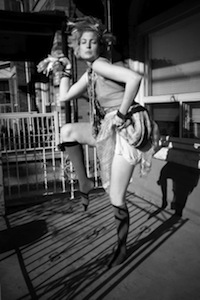
"The Hits of Lady Dada : Baroness Elsa von Freytag-Loringhoven"
Whether in art, politics, love or warfare, history is said to be written by the victors. The importance of Marcel Duchamp’s 1917 Fountain is surely beyond any doubt, having changed the entire art historical narrative irrevocably. In 2004, to no-one’s great surprise, it was voted the most influential artwork of the 20th century by 500 selected art world professionals. This article is not about to argue any different. But what if Fountain, that most influential artwork, was maybe the idea of someone else entirely, someone whose place in art history was largely forgotten and has only recently come to light?
In a 1917 letter from Duchamp to his sister Suzanne, he informed her that his submission to the Society of Independent Artists was in fact conceived by a friend:
“One of my female friends who had adopted the pseudonym Richard Mutt sent me a porcelain urinal as a sculpture; since there was nothing indecent about it, there was no reason to reject it.”
So could this mysterious friend have been Baroness Elsa von FreytagLoringhoven, and who was she anyway?
The Baroness was born in 1874 in Pomerania, Germany, and spent much of her early life as an actress and vaudeville performer. She had numerous affairs with artists in Berlin, Munich and Italy, studied art in Dachau, and married an architect in Berlin in 1901. This marriage became a ménage à trois with the poet and translator Felix Paul Greve, and in 1910 she emigrated to America with him. On moving to New York in 1913 she married the German Baron Leopold von Freytag-Loringhoven, got a job in a cigarette factory, and fell in with the city’s nascent Dada scene. Baron von Loringhoven hurried back to Germany at the outbreak of war, where he shot himself – an act which his wife characterised as the “bravest of his life”.
Freytag-Loringhoven cut an eccentric figure on the New York streets with her shaved head, black lipstick and riotous outfits of found-object ensembles, among them a tomato-can bra, a birdcage hat with live canary, and postage stamps pasted to her cheeks. She modeled for artists including Man Ray, and appeared in a short film by Ray and Duchamp titled The Baroness Shaves Her Pubic Hair. She wrote poetry that was published in the Little Review and inspired Ezra Pound, who wrote in his Cantos that the Baroness lived by a “principle of non-acquiescence.” While pursuing a thorough dismantling of the boundaries between art and everyday life, she created artworks whose existence has survived through many years of obscurity. The irreligious Dada object God is a 10½ inches high cast iron plumbing trap turned upside down and mounted on a wooden mitre box, a 1917 readymade that’s contemporaneous with Fountain and is now exhibited alongside it in the Arensberg Collection at the Philadelphia Museum of Art.
After her flowering with New York Dada, Freytag-Loringhoven was cut adrift when many of her fellow artists and poets returned home to Europe after the war. By the time she’d inherited enough money to travel to Paris in 1926, she was in declining health and dismayed by the many rejections of her English-language poetry in her resolutely Francophone new home. A disastrous stay in post-war Berlin came to nothing, though a return to Paris the following year seemed to promise some improved mental stability. However. she was to die alone of gas suffocation in her flat, either by suicide or fatal accident. She is buried at Paris’s Père Lachaise Cemetery.
The Baroness’s place in history might have been condemned to a mere footnote but for a sudden resurgence of interest in this unique Dada trailblazer. In 2003, Irene Gammel’s Baroness Elsa: Gender, Dada, and Everyday Modernity told her extraordinary story in the context of feminist body art and performance art, while Body Sweats: The Uncensored Writings of Elsa von Freytag-Loringhoven was listed by The New York Times as one of the notable art books of 2011. Even her unique and inflammatory fashions have appeared on the catwalks: for spring 2009, Maison Martin Margiela paraded models wearing a collection made entirely of refuse, and in winter 2009 Agatha Ruiz de la Prada took Elsa’s signature birdcage as the design cue for a skirt. The Baroness’s life and work had always defied specific categories, and she foresees junk art, performance art, body art, collage, found sculptures and assemblage by decades. It’s been a long time coming, but Baroness Elsa can finally claim a kind of victory.